Section outline
-
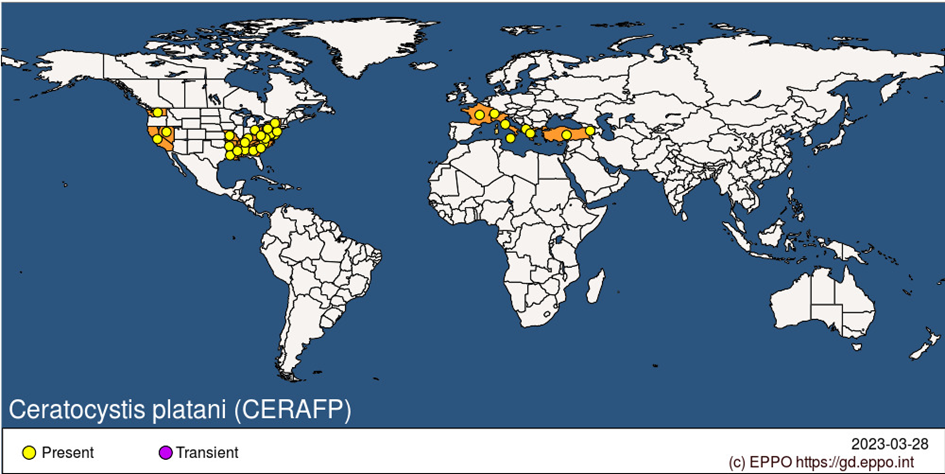
Ceratocystis platani was most likely introduced into several southern European ports from the USA at the end of the Second World War on infected wood packaging material, after which it spread rapidly in Italy (Panconesi, 1981) and more slowly in France (Vigouroux, 1979a). Initially, the western part of Vaucluse (south-eastern France) was severely affected. Recently, infected 200-years old P. x hispanica along the Canal du Midi in south-western France were felled, which received considerable media attention. The disease was reported several times in Spain, but only confirmed in 2010 in Girona, Catalonia, in a region bordering affected areas of France (EPPO, 2014; Riba, 2011), an outbreak now considered eradicated. The disease is known in Switzerland, Greece, Albania and Turkey. Unverified reports suggest that the disease is also present in Armenia (Simonian and Mamikonyan, 1982) and Iran (Salari et al., 2006). Abundant dying and dead P. orientalis were observed in valleys approaching the North Macedonian border in 2022 (Doğmuş & Woodward, 2022, personal observations), suggesting that spread is continuing in the Balkans Peninsula.
EPPO Region: Albania, Armenia, France (mainland), Greece (mainland), Italy (mainland, Sicilia), Switzerland, Türkiye.
North America: United States of America (Alabama, Arkansas, California, Delaware, District of Columbia, Georgia, Kentucky, Louisiana, Maryland, Mississippi, Missouri, Nevada, New Jersey, New York, North Carolina, Ohio, Pennsylvania, South Carolina, Tennessee, Virginia, Washington, West Virginia).