Section outline
-
Ecological Impacts
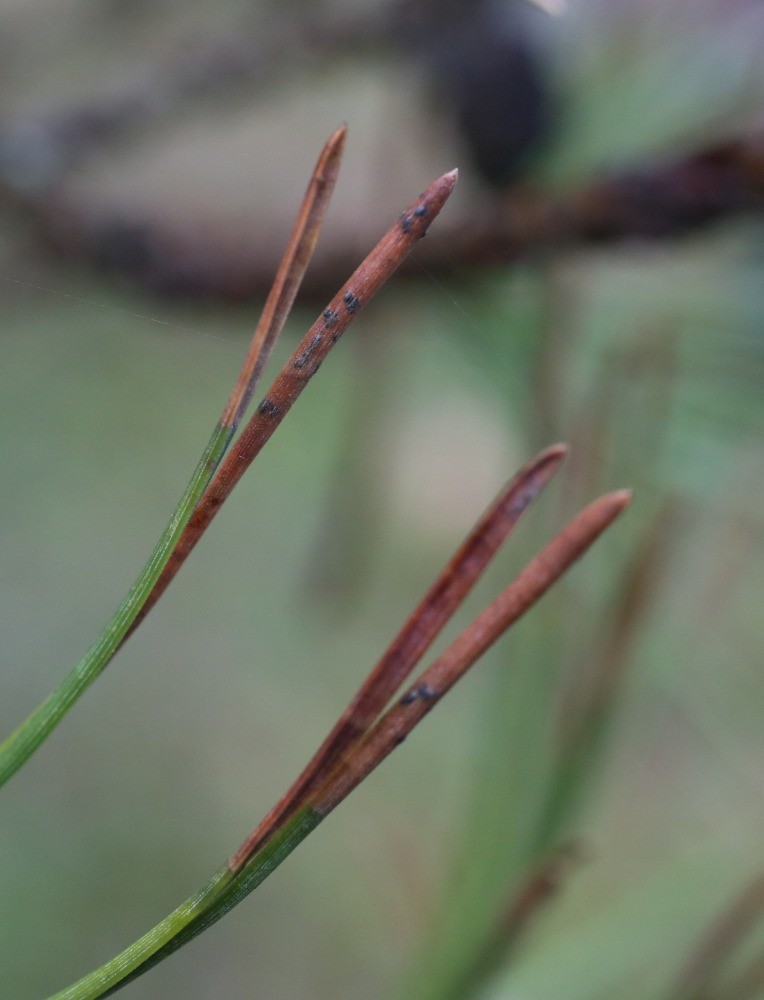
L. acicola slows down growth of pines or even delimits their existence being the most severe problem in the juvenile phase of a tree. Pines have normally high demand on light, therefore they cannot survive in understory of a mixed forest in case they are suppressed by infection of the brown spot needle blight. Pine forests and their habitat play often an important ecological role due to high tolerance of pines to drought and nutrient content in soil, ability to survive in wetlands or naturally afforest or regenerate at clearings as a pioneer. Probably the most critical ecological role it plays in mountains, close to the tree-line, where it exhibits its extreme tolerance to a harsh environment. Records of L. acicola from past 15 years come often from these specific sites, where the role of pine is crucial, like for example peat bogs (Jankovský et al. 2009, van der Nest et al. 2019) and high altitudes of Alps (La Porta and Capretti 2000).
Indirect, but strong ecological impact has been noted in the USA where one of the earliest methods used against L. acicola on the fire-tolerant P. palustris were large controlled burns (Hedgecock, 1929).
Economic Impacts
Probably the most severe economic impact of L. acicola was calculated in the USA. The timber losses on P. palustris and other infected species in 1980s exceeded 453,000 cubic meters per acre (Cordell et al. 1990). But the losses were reported not only on timber. L. acicola discoloring needles strongly affects the appearance of Christmas trees. From 1960s to 1980s millions of Christmas trees rendered unmarketable in the north-central USA (Phelps et al., 1978). The economic impact on amenity trees in municipal greens is obvious, as well as costs for eradication of the pathogen in tree nurseries.
